
Notes on wine notes
Or: how I learned to stop worrying and love the note

A lot of winos will be able to point to one particular wine that kicked open the doors in their mind, that marked a distinct beginning to their journey towards obsession. Their subsequent adventure into the stuff can be neatly traced as a desire to better understand that initial moment, a long detonation from a single fuse.
Though I’ve been lucky enough to have my fair share of revelatory moments, my own history of wine isn’t so neat, and I have never been able to pinpoint that one glass that tipped me over. It was a strange process of casual interest morphing into frantic swotting, settling into a lasting passion. But one decision which I credit with fomenting this shift more than any other was starting to take detailed notes on the wines I was tasting.
I had previous abortive attempts to record my drinking habits — somewhere on Vivino’s servers rests a graveyard of reviews of quite dull Ocado purchases — but in July 2023 I elected to take it to the next level. I was nearly a year into taking wine more seriously by this point, but I couldn’t seem to retain much about the wines I was drinking. I finally thought to myself that it seemed insane that I expected to remember anything at all with no attempt to commit these facts to memory. If I had just sat in lessons at school without doing any actual work, would I have learned or remembered anything there?
I decided I would record every wine I tried for a whole year in great detail, then see where I ended up. I excluded events such as wine fairs where I might expect to taste a hundred tiny pours, half with a rapidly frying palate. Otherwise, everything was on the table.
Not wanting to be drawn on 50 or 100-point scores for anything, I made my own spreadsheet with separate rows for every single piece of information I wanted to retain about a given wine: vintage, producer, name, region, appellation, grape varieties and colour. Then there was the contextual stuff: where it was tasted, whether I had a glass or bottle, price… On top of this I allowed myself a primitive rating system: horrible, fine; good/great, fantastic, truly special.
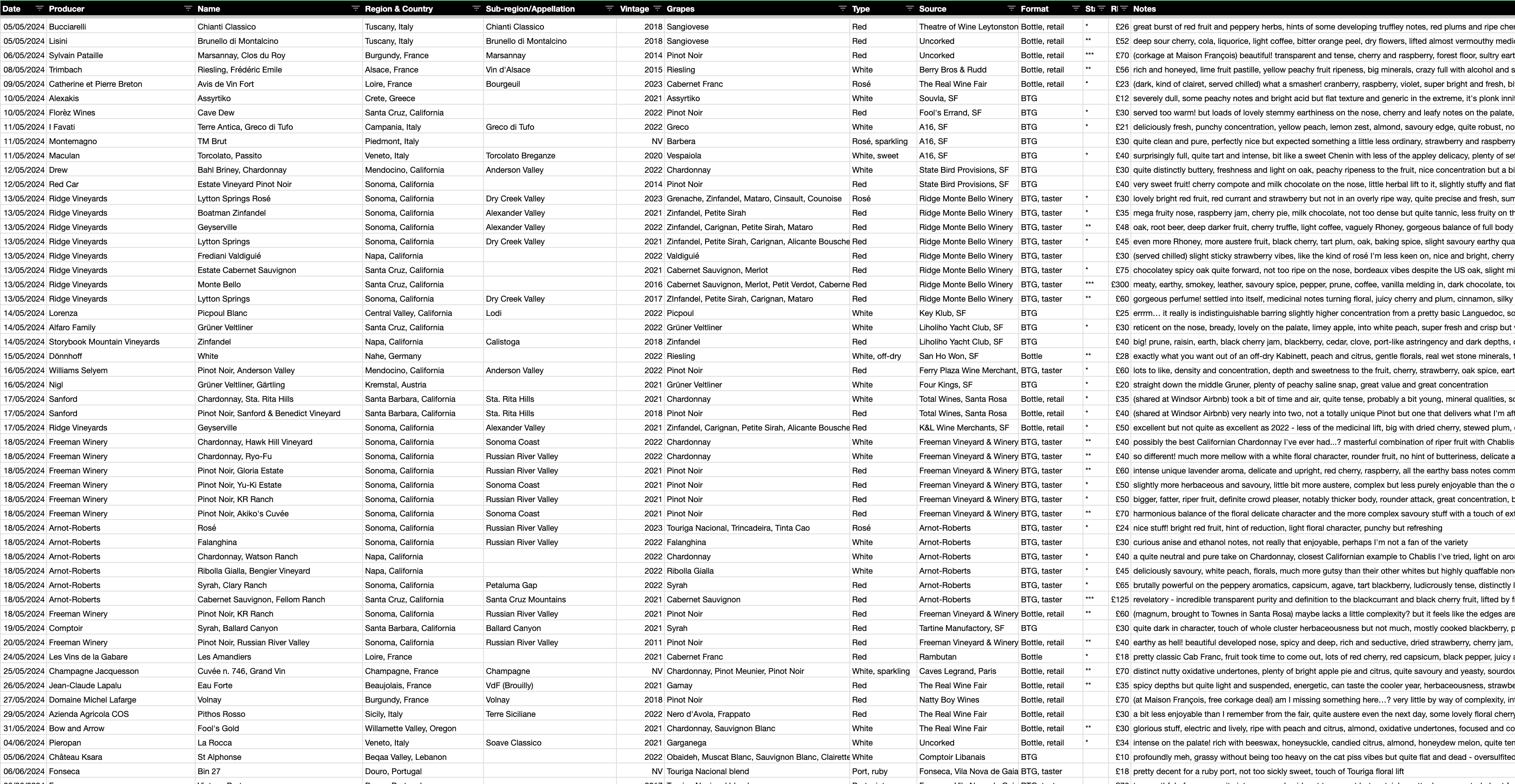
Initially these were meant to be a tiny bit of first-thought context, nothing too involved, written in the moment. “Glou glou, good value”, reads my entire note for — what else? — 2022 Raisins Gaulois. Very quickly however, they began to turn into a sort of extended sensory inventory: while none of them were ready-made tasting note copy, it wouldn’t take much to convert them. A note for 2020 Château de Bonnezeaux’s Coqueries gives an indication of their rambling, enthusiastic style:
“yeeesh! marzipan, hay, baked buttery apple, lemon curd, cassia, honey, alcohol, waxy unctuous fullness but quite upright, lasting broad mineral saline finish, closed on the nose at first but opened up nicely, like drinking a pear frangipane tart, beautiful!”
In practice, this created situations where I would need to take five minutes out of the moment each time I tasted a new wine to tap away at my phone. Not such an issue at a dedicated wine tasting perhaps, or with a bottle open at home; frankly disastrous with company at a restaurant when you’ve ordered a wine pairing. The times where I couldn’t easily make a good note there and then necessitated revisiting the spreadsheet to fill it in after the fact. A backlog of these events occasionally accumulated; I can’t pretend I enjoyed the moments where I found myself bringing my laptop out at 10pm to perform data entry for a dozen wines, desperately trying to remember whether one of them was giving me peach or apricot.
663 notes later, I emerged from my year of note-taking having made an exponential leap in my own knowledge, a solid foundation formed through that repeated act of recording. But I couldn’t get away from the fact that I wasn’t enjoying all this essentially unpaid work very much anymore. I feebly attempted to continue for a few months, eventually succumbing to the desire to enjoy a glass of wine without feeling like I was studying for a test on it. Of course, I still took notes at trade tastings or producer visits, but I completely stopped taking notes recreationally.
Months passed in my new, carefree, note-free existence. I looked back on the period preceding it with fondness and mild discomfort. Thinking about taking notes in that way again felt maddening, like volunteering to redo my GCSEs. It had served its purpose: I had so much context in my head that remembering new wines was far, far easier than it ever had been. Notes were a means to an end, and I was at the end.
Eventually, I started to notice that my vocabulary was shrinking. I was losing articulacy, stumbling over what I wanted to say when describing wines to customers. I found myself just drinking wines, as I’d essentially intended when I stopped note-taking, but sometimes without properly noticing them. All well and good for a glass of basic Bojo perhaps — that’s very much the point — but this was happening for wines I should have been paying more attention to. I absorbed less, I remembered less. Despite my working for a wine merchant, a grand dulling of my wine brain was slowly happening, a softening and thickening of my skills and reflexes.
The act of taking a note is perfect insurance against taking a wine for granted. I needed that appreciation back, and I needed to flex my wine communication muscle once again, lest I find myself shipwrecked on basic terms the next time I tried to recommend a wine. By stopping taking notes at all, I’d thrown the baby out with the bathwater. All forms of truly engaged tasting are essentially mindful practice, a guarantee that you will take a moment to check in with your senses; I just had to find a more sustainable way to encourage it.
At the tastings I run, I make tasting sheets for everyone, and I gently suggest that everyone at least takes a moment to write down a basic impression of each wine, even if it’s just a couple of words. If they don’t want to they certainly don’t have to, but I do try and explain the fact that it prevents that familiar situation of the wine just disappearing from your glass over the course of your conversation. I now view this process even at its simplest as almost essential to unlocking an interest in wine; there is no surer way to create the space for more profound wines to make an impression and justify themselves to you. The finest wines are still just wine if they’re indiscriminately chugged, even if the chugging is accidental.
This year, I made a new spreadsheet, much simpler this time, with just the vintage, producer and wine name recorded. I won’t be recording every wine; in fact, I’ll only record bottles, not glasses. Like all of my most rewarding vices, I’m taking notes in moderation.